LABoral opens a new chapter with its 2026 programme
LABoral Art and Industrial Creation Centre has presented its annual programme. For its newly appointed director, Semíramis González, the presentation marked a public statement of intent after months of internal work and the first visible step in a new direction that looks to the future without losing sight of the centre’s founding spirit.
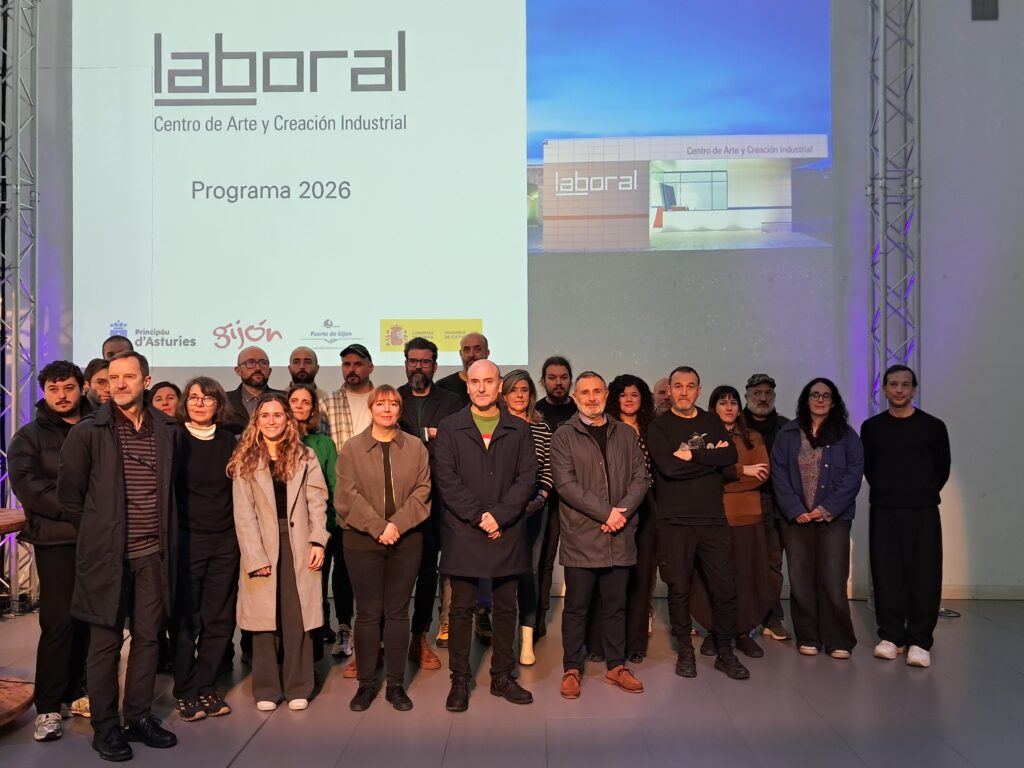
González chose to be accompanied by partners, collaborators and cultural agents in a broad “family photo” that brought together programmers from Gijón and Oviedo, gallery owners, institutional representatives, members of the Oviedo School of Art and the University of Oviedo, as well as artists, musicians, curators and professionals from the audiovisual and contemporary arts sectors. The event was also attended by the Oviedo 2031 team, closely following a programme that strengthens Asturias’ position within national and European cultural circuits — a strong show of support that did not go unnoticed and was highlighted at the opening of the event by the Regional Director General for Culture, Pablo León.
The director spoke of a desire to “return to being” the LABoral of its early years: a national benchmark for contemporary art. The 2026 programme builds on initiatives launched by the previous team — “everything that works should continue to work” — while significantly expanding institutional and cultural partnerships. Collaboration is strengthened with the Gijón City Council, the Gijón Port Authority, the Oviedo School of Art and the University of Oviedo, alongside a consolidated network of national and international partners including CentroCentro (Madrid), the Museo Reina Sofía, the Thyssen-Bornemisza Museum, Tabacalera and iMAL (Brussels).
The residency programme gains greater prominence as a space for artistic production, research and networking, while the centre’s international dimension is further reinforced through Creative Europe projects such as EMPA Extended and European Hybrid Intelligence. The exhibition programme includes projects such as De rerum natura, The Automatic Society by Félix Luque, initiatives based on urban routes, and new lines of work linked to European programmes.