Conversations with three European experts on Oviedo’s bid to become European Capital of Culture
Oviedo’s bid to become European Capital of Culture has entered a key moment. With the dossier almost finalised and February marked in the calendar for the defence before the European jury, the project is approaching the final stretch of its first phase. A decisive moment that invites reflection on what it really means to aspire to this title and what its purpose is.
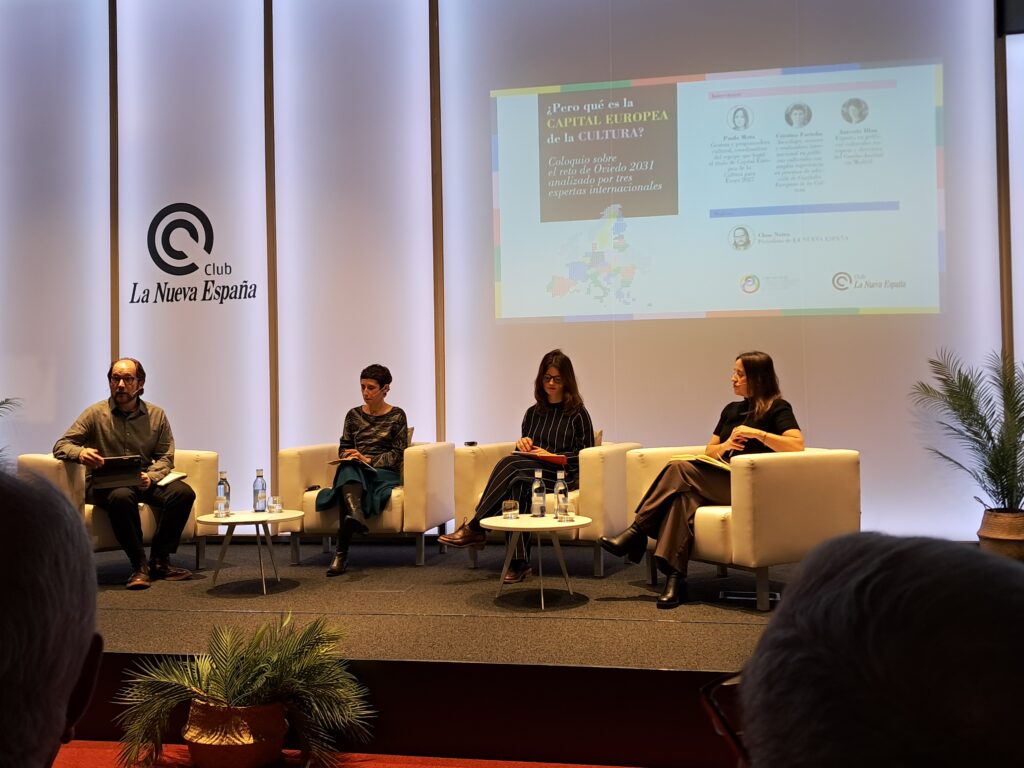
This was the focus of the meeting held at the Club of La Nueva España, which brought together three international experts: Cristina Farinha, evaluator of the European Capital of Culture programme; Paula Mota, former director of Évora 2028; and Antonia Blau, Director of the Goethe-Institut in Madrid. Moderated by journalist Chus Neira, the debate shared a clear idea: the European Capital of Culture is not a prize or a showcase, but a process of deep urban transformation.
Cristina Farinha reviewed the evolution of a programme that is now forty years old and that today requires much more than a strong cultural programme. The title demands a solid, participatory strategy with long-term impact, in which culture acts as a driver of urban, social and economic change. Cities such as Lisbon, Porto and Guimarães marked this shift by incorporating urban regeneration, professionalisation of the cultural sector and active citizen involvement.
Antonia Blau highlighted the European dimension of the programme, which places cities and their residents at the centre of the common project. Her experience in Marseille 2013 illustrated how the title can help redefine a city’s image, strengthen its self-esteem and reposition it on the European cultural map.
Paula Mota, meanwhile, underlined the collective nature of these processes, which require the courage to look honestly at weaknesses and turn them into opportunities. In Évora’s case, the project was born from deep listening to the territory and its people and articulated around a shared cultural concept.
The meeting left a message that is especially relevant for Oviedo at this stage: beyond the final result, the true value of the bid lies in the process itself. A process that encourages the city to reflect on its future, involve its people and use culture as a tool for transformation. That work, regardless of the outcome, is already leaving its mark.